Affiliate disclosure: This article contains Amazon affiliate links. As an Amazon Associate, Glowstice earns from qualifying purchases — at no extra cost to you. Our editorial recommendations are independent of these partnerships. Learn more · How we evaluate products
Quick Picks
Affiliate links: we may earn a commission at no extra cost to you.
| Product | Price | Link |
|---|---|---|
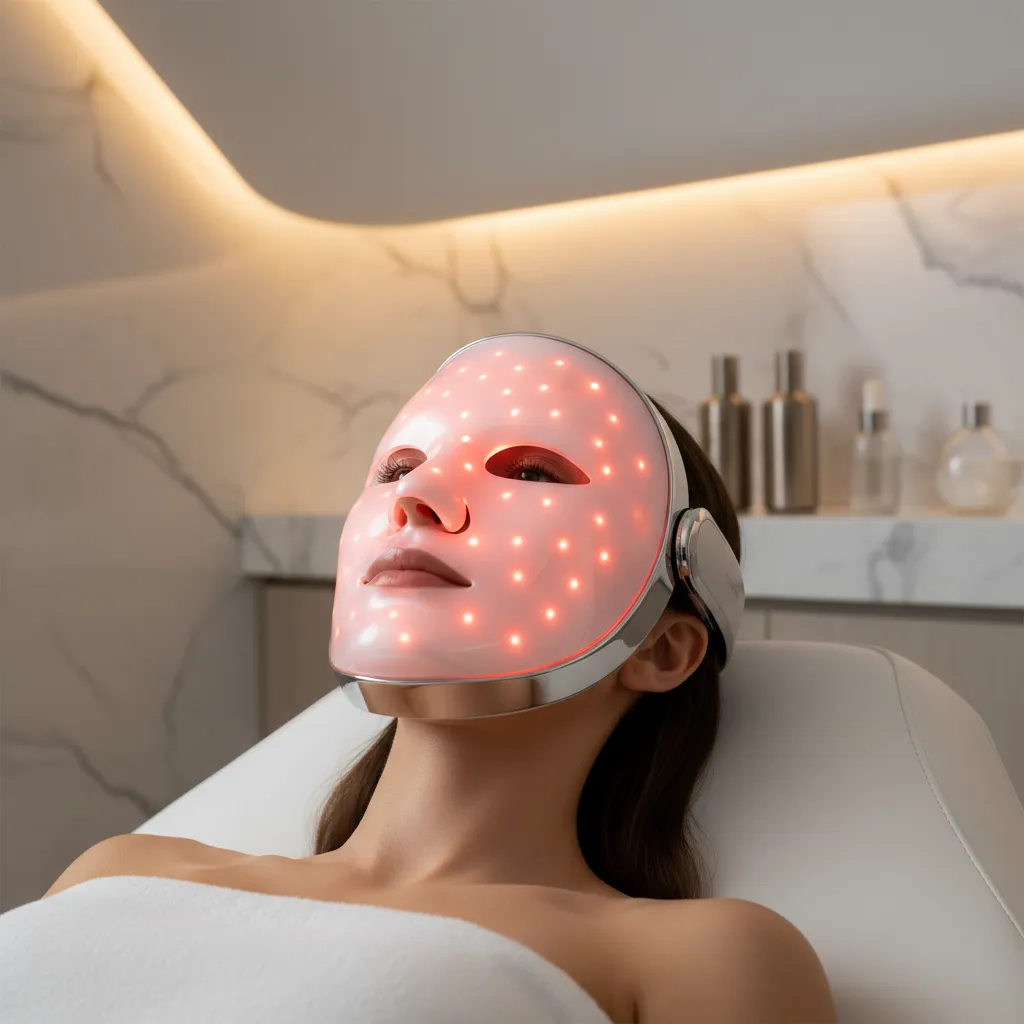
633nm + 830nm flexible silicone LED mask — clinical-grade dual wavelength Omnilux Contour FACE — 633nm + 830nm | ~$440 | Shop Now → |
Prices last checked on September 28, 2026 and rounded to the dollar. Amazon prices change often; the price shown at checkout is the one that applies.
The single most common and most costly mistake in purchasing light therapy devices is treating red light and near-infrared as interchangeable. They are not. Red light (630–680nm) and near-infrared (810–850nm) have fundamentally different depths of tissue penetration, different primary biological targets, and — consequently — entirely different clinical applications. A device with only red light will excel for skin surface concerns; a device with only near-infrared is better suited for deep tissue recovery, joint health, and systemic effects. Understanding this distinction is the difference between an effective tool and an expensive disappointment.
The Physics of Light Penetration Through Biological Tissue
The depth to which any wavelength of light penetrates biological tissue is governed by two competing optical processes: absorption and scattering.
Absorption: Different molecules in biological tissue absorb different wavelengths. Melanin (dominant in the epidermis) absorbs strongly across the visible spectrum, with absorption coefficient decreasing from blue to red. Oxyhemoglobin and deoxyhemoglobin absorb most strongly in the 400–600nm range. Water absorbs strongly in the infrared above 1,000nm. The 600–1,000nm range is the 'therapeutic window' — all three major absorbers have relatively low absorption coefficients, allowing light to penetrate significantly deeper than visible blue or green wavelengths.
Scattering: Biological tissue is highly scattering due to cell membranes, organelles, and collagen fibers. Scattering coefficient decreases with increasing wavelength — meaning longer wavelengths scatter less and penetrate more linearly into tissue. This is why near-infrared at 830nm penetrates significantly deeper than red at 630nm even though both are within the therapeutic window.
Practical penetration depths: 630nm red light penetrates approximately 5–10mm into tissue — reaching the epidermis, dermis, and subcutaneous fat. 830nm near-infrared penetrates 20–50mm — reaching muscle tissue, superficial bone, joint capsules, and peripheral nerves. These depths determine which biological structures each wavelength can therapeutically dose.
Red Light (630–680nm): Skin, Dermis, and Superficial Tissue
At 630–680nm, the primary photobiological target is cytochrome c oxidase (CCO) in the mitochondria of cells within the epidermis and dermis. The dermal fibroblast population — the cells responsible for synthesizing collagen, elastin, and the extracellular matrix — is the key effector cell for anti-aging applications.
Documented effects of red light on skin tissue:
Collagen synthesis: Multiple controlled studies confirm increased type I and III procollagen synthesis in fibroblasts following red light irradiation at 630–670nm. Studies by Barolet et al. have shown statistically significant wrinkle reduction and improved skin texture with regular red light application.
Wound healing: Red light accelerates epidermal re-epithelization, increases fibroblast migration and proliferation, and reduces wound contraction time. These effects make it the standard light therapy application for post-procedure recovery after microneedling, chemical peels, and fractional laser.
Sebum modulation: Red light at 630nm reduces sebum production through effects on sebocytes in the sebaceous gland — contributing to its acne-management role beyond the anti-inflammatory mechanism.
Skin concerns best addressed by red light specifically (not NIR): fine lines and wrinkles, skin texture refinement, post-procedure recovery, photoaging reversal, acne (inflammatory type, combined with blue light), collagen stimulation.
Related Reading
Editor's Product Picks
Affiliate links — we earn a small commission at no extra cost to you.

630nm + 830nm Dual-Wavelength LED Face Mask
What to look for — not a specific product$200–$450 typical range
Shop Now →
Near-Infrared Body Panel 850nm
What to look for — not a specific product$150–$400 typical range
Shop Now →
Omnilux Contour FACE — 633nm + 830nm
~$440
Sold by Posh Gifts Online, a third-party sellerShop Now →Targeted Red + NIR Handheld Wand
What to look for — not a specific product$80–$200 typical range
Shop Now →Prices last checked on September 28, 2026 and rounded to the dollar. Amazon prices change often; the price shown at checkout is the one that applies.
Near-Infrared (810–850nm): Deep Tissue, Joints, and Systemic Effects
Near-infrared light at 810–850nm penetrates 30–50mm into tissue, reaching structures that 630nm red light cannot therapeutically dose: skeletal muscle, joint capsules, synovial tissue, tendon, ligament, periosteum (outer bone surface), peripheral nerves, and — in thin tissues or when applied to the skull — superficial brain regions.
Documented effects of NIR on deep tissue:
Muscle recovery: Multiple randomized controlled trials demonstrate that NIR irradiation before or after intense exercise reduces delayed-onset muscle soreness (DOMS), decreases creatine kinase release (muscle damage marker), and improves subsequent exercise performance. A 2016 meta-analysis in the Journal of Photochemistry and Photobiology confirmed significant effect sizes across 17 RCTs.
Joint and arthritis: NIR photobiomodulation has documented anti-inflammatory effects on synovial tissue and has shown clinical efficacy in knee osteoarthritis and rheumatoid arthritis in multiple controlled trials.
Testosterone and hormones: This claim is frequently repeated in biohacking and NIR-panel marketing but deserves real scrutiny. The most-cited human study often invoked here (a 2016 University of Siena trial) actually used bright white light exposure in the morning, not near-infrared irradiation applied to the body, and found a testosterone increase through a light-exposure/circadian mechanism unrelated to topical NIR panels. Genuine animal studies applying near-infrared light directly to testicular tissue exist (in mice, from 2020–2021), showing increased testosterone and improved sperm parameters via a proposed Leydig cell mitochondrial mechanism — but these are preclinical, not human trials, and the specific 2016 human scrotal NIR study frequently cited in consumer marketing does not appear to exist as described. Treat this specific claim as unproven in humans until better evidence emerges.
Neurological: NIR at 810nm can reach prefrontal cortex when delivered transcranially. Pilot studies show potential for improved cognitive function, reduced depression markers, and neuroprotective effects — a rapidly growing area of photobiomodulation research.
Why the Best Devices Combine Both Wavelengths
For comprehensive photobiomodulation, combining red (630–670nm) and near-infrared (810–850nm) wavelengths in the same device session is more effective than either wavelength alone for most applications.
For skin: Red light handles superficial collagen stimulation and epidermal effects. NIR penetrates to the deeper dermis and subdermis, stimulating fibroblasts in deeper tissue layers that red light under-doses. The synergistic collagen stimulation from both layers produces thicker, more structurally improved skin than either wavelength in isolation.
For post-procedure recovery: After microneedling or laser, the skin requires both epidermal repair (red light) and suppression of deeper inflammatory mediators (NIR). Combined-wavelength protocols accelerate recovery more than red-only.
For systemic benefit: Users seeking the hormonal, recovery, and neurological benefits of NIR can simultaneously address skin quality with red — eliminating the need for separate device sessions.
The most studied pairing in clinical photobiomodulation is red light (around 630–633nm) plus 830nm near-infrared, the combination used by Omnilux. This combination is the most studied and clinically supported dual-wavelength protocol.
Choosing Wavelengths for Your Specific Goals
Use this framework to select the right wavelength profile for your primary goals:
Primary goal: Skin anti-aging, fine lines, texture, collagen → Red (630–670nm) required. NIR adds benefit but is not the primary driver. A red-dominant or red+NIR face mask is the right tool.
Primary goal: Acne treatment → Blue (415nm) + Red (630nm) combination. NIR provides additional anti-inflammatory support but is secondary. Face masks with blue + red are the core recommendation.
Primary goal: Post-workout recovery, DOMS reduction, muscle soreness → NIR (810–850nm) is the primary wavelength. Panel-format or targeted devices delivering NIR at adequate dose to muscle tissue.
Primary goal: Joint pain, osteoarthritis, tendinopathy → NIR (810–850nm). The wavelength must penetrate to joint capsule depth (30–50mm). High-irradiance panel or targeted NIR device.
Primary goal: Systemic benefits (sleep, testosterone, energy) → NIR (810–850nm), full-body panel. Red can be added for simultaneous skin benefit but is not required for systemic outcomes.
Primary goal: Scalp and hair growth → 650–670nm (red) primarily; NIR can be added for deeper follicle penetration. Laser caps operating at 650nm are the FDA-cleared standard.
Author
Glowstice Editorial
The Glowstice editorial team consists of skincare researchers, cosmetic chemists, and science writers dedicated to translating peer-reviewed dermatology into practical guidance for curious consumers.